How to Choose an Espresso Machine for Home: 7 Key Things to Know
Editor’s Note: This guide is research-based and is designed to help shoppers understand the main decisions involved in choosing an espresso machine for home use. It is not a hands-on test.
Buying an espresso machine is easier when you start with your workflow rather than a feature list. A machine can have impressive specifications and still be a poor fit for your kitchen, your coffee habits, or the amount of control you want over each shot.
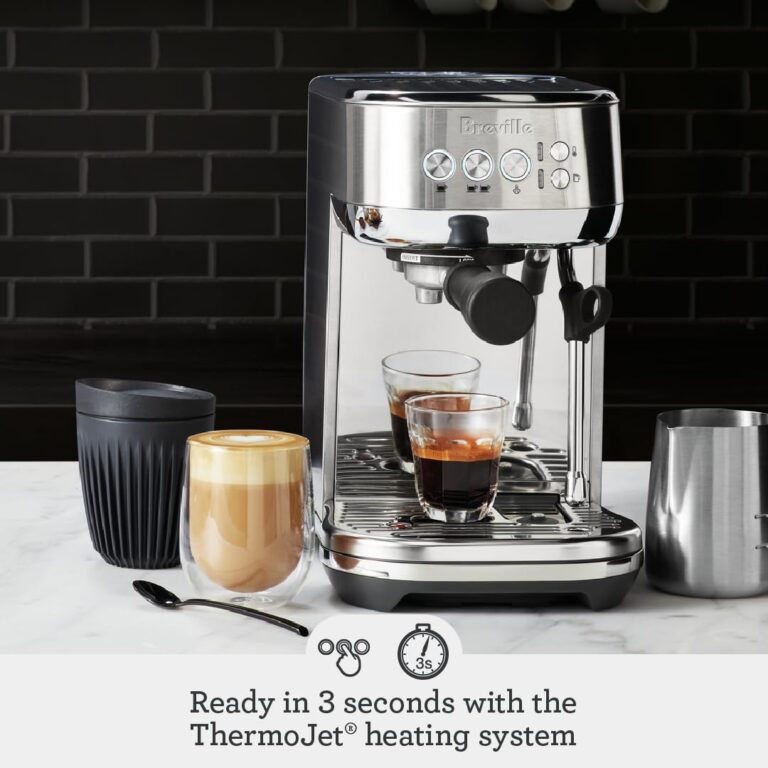
For example, the Breville Bambino Plus focuses on a compact setup and automatic milk texturing, while the Breville Barista Express combines espresso brewing with an integrated grinder and manual milk steaming. Breville’s current U.S. comparison page highlights those differences along with their different footprints, heating systems, capacities, and warranties.
1. Decide How Involved You Want to Be
The first question is simple: do you want espresso to be quick and repeatable, or do you enjoy the process of dialing in coffee and learning technique?
- More convenience: look for simple controls, fast heat-up, and features that reduce manual steps.
- More control: prioritize adjustable brewing variables, a capable grinder, and a manual steam wand.
- A balance: choose a machine that keeps the basic workflow simple but still lets you improve your technique over time.
2. Think About the Grinder Before the Machine
Espresso machines and grinders solve different problems. A machine controls water delivery and extraction; the grinder determines how finely and consistently the coffee is prepared before brewing. You can compare the main heating and boiler designs in our espresso machine types guide before narrowing your shortlist.
That makes the grinder an important part of your budget. The Barista Express includes an integrated steel conical-burr grinder with 16 precision grind settings, while the Bambino Plus has no integrated grinder. With the Bambino Plus, you can choose a separate grinder and upgrade it independently later.
3. Check the Milk Workflow
If you mostly drink espresso or Americanos, milk-steaming features may be less important. If you regularly make lattes or cappuccinos, the steam system should be part of your buying decision from the start.
The Bambino Plus uses hands-free automatic milk texturing with adjustable milk temperature and texture settings. The Barista Express uses a manual steam wand, which gives you direct control but requires more practice. Neither approach is automatically better; the right choice depends on how much technique you want to learn.
4. Measure Your Counter Space
Do not wait until after purchase to check the dimensions. Measure the width, depth, and usable height of the space, and remember that you also need room to fill the water tank, access the grinder or controls, and remove the portafilter.
As a useful example, Breville lists the Bambino Plus at 11.9 × 7.4 × 14.3 inches, while the Barista Express is approximately 15.9 × 13.1 × 12.4 inches. The larger Barista Express footprint is partly explained by its integrated grinder and all-in-one design.
5. Understand What Temperature and Pressure Features Actually Mean
Marketing terms such as PID, ThermoJet, Thermocoil, and 15-bar pump can be useful, but they should not be treated as a simple scorecard where a bigger number automatically means better espresso.
For example, both the Bambino Plus and Barista Express use PID temperature control and a 15-bar Italian pump, while Breville describes both systems as using low-pressure pre-infusion followed by high-pressure extraction. The machines still produce different workflows because their heating and control systems are designed differently.
The Specialty Coffee Association maintains equipment standards and testing frameworks for espresso machines and grinders. That is useful context when evaluating technical claims, but a standard or certification should not replace consideration of your actual use case.
6. Consider the Long-Term Setup, Not Just the Machine
An espresso machine is part of a small system that can also include a grinder, scale, tamper, coffee beans, water treatment, milk pitcher, and cleaning supplies. Before buying, think about which components you already own and which you may add later. Our guide to essential espresso accessories for a home setup helps separate useful basics from optional extras.
- Starting from zero: an all-in-one machine can reduce the number of separate purchases.
- Already own a grinder: a machine without an integrated grinder may make more sense.
- Planning to upgrade: a modular setup lets you replace one component without replacing the whole system.
7. Match the Machine to Your Daily Routine
The best espresso machine for you is often the one you will actually enjoy using several times a week. A technically capable machine that feels too complicated may spend more time unused than a simpler machine that fits your routine.
| Your priority | What to look for |
|---|---|
| Small kitchen | Compact footprint and easy access to the water tank |
| Fast morning routine | Quick heat-up and simple controls |
| Milk drinks | Steam wand or automatic milk texturing that matches your skill level |
| Full control | Manual workflow and adjustable brewing variables |
| Fewer separate devices | Integrated grinder and all-in-one design |
| Future upgrades | Separate grinder and modular equipment choices |
Bambino Plus or Barista Express: A Practical Starting Point
These two machines show why there is no universal winner. The Bambino Plus is a particularly relevant example for shoppers who prioritize compactness, quick readiness, and automatic milk texturing. The Barista Express is a relevant example for shoppers who want an integrated grinder and a more hands-on workflow.
We cover the differences in more detail in our Bambino Plus vs Barista Express comparison.
Final Checklist Before You Buy
- Measure your available counter space.
- Decide whether you need an integrated grinder.
- Choose between automatic convenience and a more manual workflow.
- Consider how often you make milk-based drinks.
- Budget for the grinder and other essential accessories.
- Read the manufacturer’s specifications and support documentation before purchase.
Sources
- Breville U.S. — Barista Express vs Bambino Plus comparison
- Breville U.S. — Bambino Plus (BES500)
- Breville U.S. — Barista Express (BES870)
- Specialty Coffee Association — Coffee equipment standards and testing frameworks